Solar Eclipse in a Graveyard!

I just had the most awesome cemetery afternoon ever!

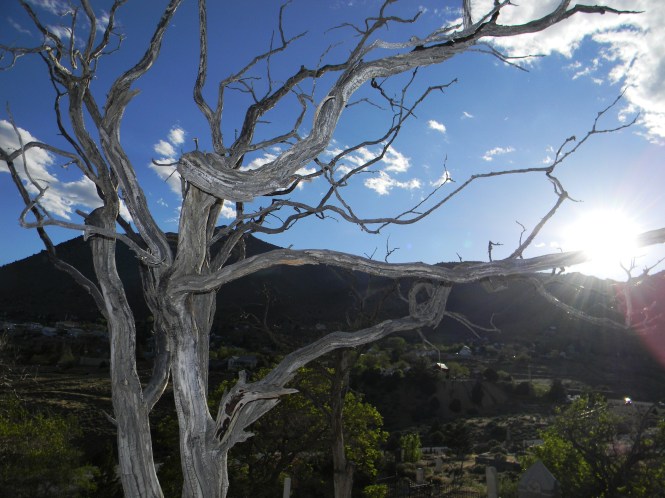
I went to Virginia City, Nevada to check out a gorgeous old graveyard.

Had no idea there was about to be an annular solar eclipse until an excited group of folks with welders’ masks and funky glasses showed up and clued me in.

They loaned me their glasses so I wouldn’t burn out my retinas – think old style 3D glasses from the 50’s.

OMG! The view was so cool.

Eclipse Annular

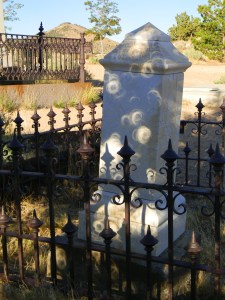
I paid back their kindness by showing them eclipse shadows on a couple of tombstones.  These shadows are nature’s way of letting us see an eclipse safely.  You could do the same thing with a pin hole projector.
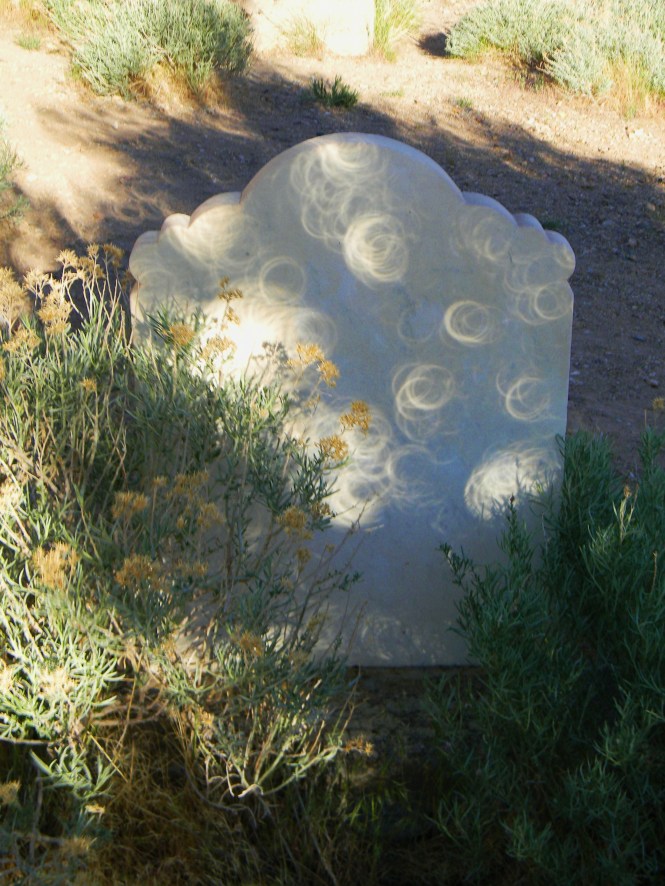
The needles of a juniper tree provided the pin holes for me. I think any leafy tree would do.
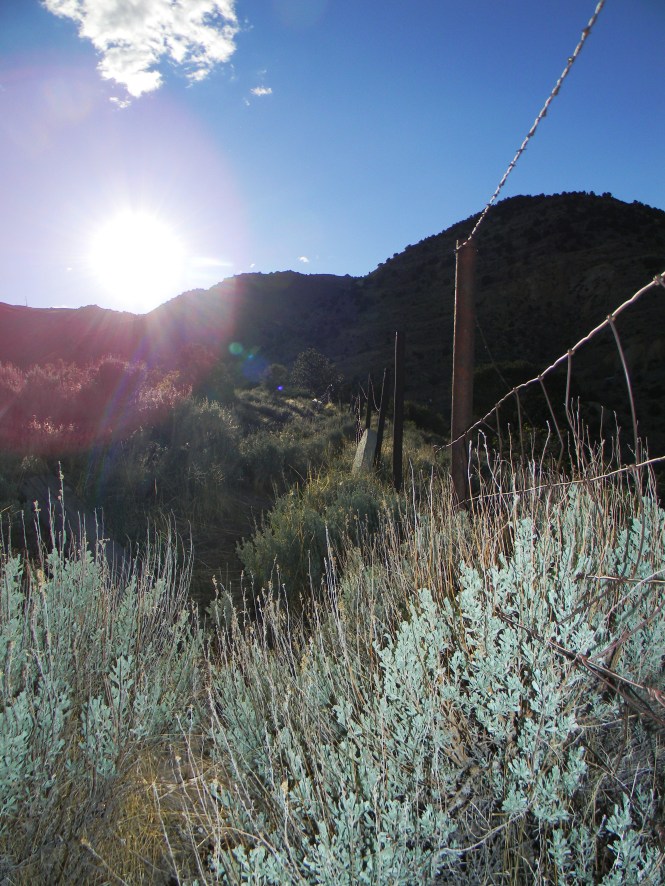
The Sierra Nevada mountains… land of pioneers, gold mines and cowboys.

Westphalia, Missouri

The discordant mix of highway noise, turtledoves and church bells lent a surreal quality to my visit to this little cemetery.

It was one of those slam on the brakes and make a right, no time for turn signals kind of stops. Ever had one of those? Two-lane, State Highway 63 twists through the eastern edge of the Ozark Mountains in southern Missouri. About 20 miles south of the capital, Jefferson City, the landscape gets more and more rural. I passed through several tiny towns before the tall, marble crucifix that marked this graveyard called my name.

I parked in a large, gravel lot in front of an auto repair shop right beside the highway. A broken down school bus sat in one corner like it’d been there for years and would be for more. A well used tow truck was parked in front of the boxy, aluminum sided shop.

The Westphalia cemetery sits right next to it on a hillside gently sloping up toward a church with a high, pointed white steeple, the source of the tolling bells.

Twilight added to a sense of being slightly off-center to reality here. My step off the gravel and onto the cemetery’s thick, well-tended lawn was like a step out of time.

Icouldn’t translate the language on the markers.

I don’t speak a word of German. Even the street signs in tiny Westphalia are printed in two languages. The flowing script on the porcelain placards was beautiful though.


Iron work crosses spoke to the poverty and austerity of the folks who settled here.

I got the feeling from looking around that not much had changed.

A Book Review

John Gary Brown, Brownie, and I met thirty years ago in Colorado. This was back in my acting days. Brownie was the photographer for Creede Repertory Theater where I’d landed the ingénue roles that summer.

He’s the first person I ever met who shared my love of cemeteries. When I sheepishly admitted to my grave addiction on a hike up West Willow Canyon with most of the acting company, the others looked at me like I’d grown an extra nose, Brownie’s eyes lit up. “Me too,” he said, “I’m thinking about writing a book.”

Brownie outside his studio


Fourteen years later, Soul in the Stone: Cemetery Art from America’s Heartland was published by the University Press of Kansas. 

Both in photography and words, Brownie articulates everything I love about wandering through graveyards. But, where I look at stones and wonder about their history, Brownie goes out and finds the stories. I’m not talking genealogy. He’s an artist – one of my ambitions in life is to own a Brownie painting.

He tells the real human story, the wealth, poverty, culture, history, often weird and funny tales that give each monument its unique significance. He sees the artist or artisan’s point of view too and reveals things about techniques, styles and types of stone that I’d never think of.

I love that.

His photos truly evoke the soul in each stone. I wish I could give you a few samples, but I didn’t want to infringe on Brownie’s copy rights. You’ll just have to go to your library or book store and order the book.

Use it as a travel guide. I guarantee Brownie will lead you to sites Michelin and Frommer never could. As he says in his introduction,

I wish to introduce the reader to a fairly comprehensive sampling of monuments, found and photographed in the course of travel and exploration… Artistic expression and the role of the cemetery in the history of art are especially emphasized in the choice of material.  I hope that this book will encourage others to explore, enjoy and perhaps document outstanding Heartland cemeteries.

Why I Love ‘Em

I love graveyards for all that they tell us, for the lives they hint at and the peace they promise every single denizen.  I suppose part of it’s that prurient fascination we all have with tragedy.  The reason Old Yeller’s a classic; why people love to read Nicolas Sparks or Jodi Piccoult and listen to sad country songs; sometimes you just want to cry.

Stone is a beautiful medium.

 Every tombstone’s a sculpture with a story.  Some speak more artfully than others, but it’s often the most crudely carved that tell the best tales.

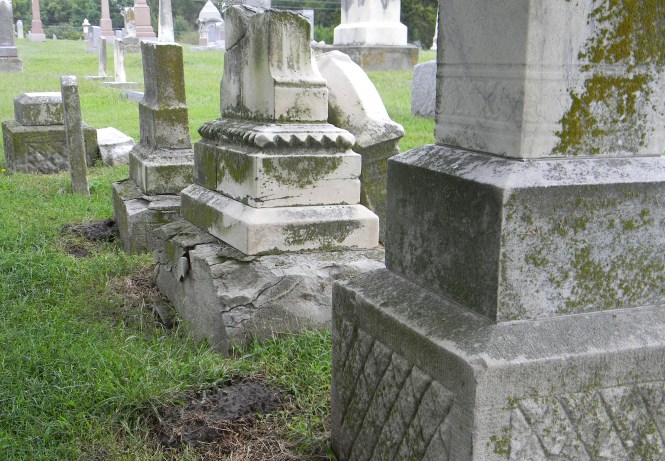
I like the colors and patterns of lichen on white marble.  I like pictures of the deceased embedded in the stones.  I like glossy new markers with sharp edges and old ones with quaint, old fashioned names.

What sparks my imagination in new and old are the hints they tell about the relationships left behind.  What happened to the family of a row of children who all died in the same year?  How much must a man have loved his wife when she died three decades before him, but he still chose to be buried beside her?

I ran across one way out in the country the other day.  It was a small cemetery on a hill thrust up from among soybean and corn fields.  There were about a hundred people buried there.  The most recent grave was less than a decade old, a double stone.  A boy, 13 years old, was buried on the right, “beloved son.”  On the left was his “loving father.”  The father’s name was there, his birth date, but no death date.  No mom.  Toy race cars and new silk flowers lay on the boy’s side.  Dad’s side was clean, empty.  Somewhere, here in my world, Dad was waiting for the day he’d see his son again.

Doesn’t that make you wonder? It’s amazing how much a few words, a trinket or two and couple of dates in stone can convey about a life, and a death.

My First Funeral

 I’ve been obsessed with cemeteries since I organized

my first funeral.Pregnant guppy

When I was a kid, one of several fishes my sisters and I kept in a freshwater aquarium died.  Since we didn’t care about him much, he didn’t really even have a name. Until we found him belly-up. Then he had to have a name – for the TOMBSTONE.

Deciding on Flashy, we made a sparkly, little casket out of aluminum foil lined with a folded square of soft, pink toilet paper. With me leading the way, I was the oldest, we carried his body slowly, in procession through the living room, the kitchen, out the back door.

At the graveside, we sang swing low, sweet chaaar-ri-ah-aht!  Words were said – sad, respectful ones about Flashy’s tragically short life.

We discussed the six-feet-under concept, but our mother convinced us — I believe her exact words were, “No, you will NOT dig a six foot hole by the back patio!”  — that six inches would be more than enough for a creature Flashy’s size.

We buried him under the Skunk bush. That was our nickname for a rare and gorgeous species of Azalea that blooms a brilliant orange, but has the unfortunately pungent scent of skunk.English: Azalea 'Hinodegiri' in full flower in...

Flashy wouldn’t mind the smell. We marked his final resting place with a Popsicle-stick-cross beautified with crayon.  There may have been tears, but I don’t think so. The feeling I remember most about the whole affair is glee.