Westphalia, Missouri

The discordant mix of highway noise, turtledoves and church bells lent a surreal quality to my visit to this little cemetery.

It was one of those slam on the brakes and make a right, no time for turn signals kind of stops. Ever had one of those? Two-lane, State Highway 63 twists through the eastern edge of the Ozark Mountains in southern Missouri. About 20 miles south of the capital, Jefferson City, the landscape gets more and more rural. I passed through several tiny towns before the tall, marble crucifix that marked this graveyard called my name.

I parked in a large, gravel lot in front of an auto repair shop right beside the highway. A broken down school bus sat in one corner like it’d been there for years and would be for more. A well used tow truck was parked in front of the boxy, aluminum sided shop.

The Westphalia cemetery sits right next to it on a hillside gently sloping up toward a church with a high, pointed white steeple, the source of the tolling bells.

Twilight added to a sense of being slightly off-center to reality here. My step off the gravel and onto the cemetery’s thick, well-tended lawn was like a step out of time.

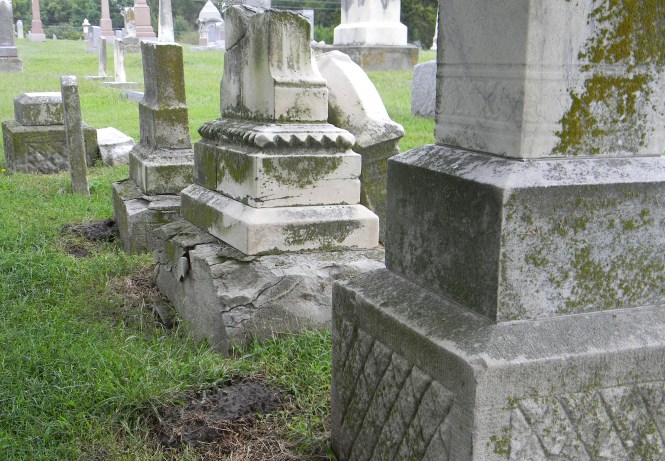
Icouldn’t translate the language on the markers.

I don’t speak a word of German. Even the street signs in tiny Westphalia are printed in two languages. The flowing script on the porcelain placards was beautiful though.


Iron work crosses spoke to the poverty and austerity of the folks who settled here.

I got the feeling from looking around that not much had changed.

A Book Review

John Gary Brown, Brownie, and I met thirty years ago in Colorado. This was back in my acting days. Brownie was the photographer for Creede Repertory Theater where I’d landed the ingénue roles that summer.

He’s the first person I ever met who shared my love of cemeteries. When I sheepishly admitted to my grave addiction on a hike up West Willow Canyon with most of the acting company, the others looked at me like I’d grown an extra nose, Brownie’s eyes lit up. “Me too,” he said, “I’m thinking about writing a book.”

Brownie outside his studio


Fourteen years later, Soul in the Stone: Cemetery Art from America’s Heartland was published by the University Press of Kansas. 

Both in photography and words, Brownie articulates everything I love about wandering through graveyards. But, where I look at stones and wonder about their history, Brownie goes out and finds the stories. I’m not talking genealogy. He’s an artist – one of my ambitions in life is to own a Brownie painting.

He tells the real human story, the wealth, poverty, culture, history, often weird and funny tales that give each monument its unique significance. He sees the artist or artisan’s point of view too and reveals things about techniques, styles and types of stone that I’d never think of.

I love that.

His photos truly evoke the soul in each stone. I wish I could give you a few samples, but I didn’t want to infringe on Brownie’s copy rights. You’ll just have to go to your library or book store and order the book.

Use it as a travel guide. I guarantee Brownie will lead you to sites Michelin and Frommer never could. As he says in his introduction,

I wish to introduce the reader to a fairly comprehensive sampling of monuments, found and photographed in the course of travel and exploration… Artistic expression and the role of the cemetery in the history of art are especially emphasized in the choice of material.  I hope that this book will encourage others to explore, enjoy and perhaps document outstanding Heartland cemeteries.

Why I Love ‘Em

I love graveyards for all that they tell us, for the lives they hint at and the peace they promise every single denizen.  I suppose part of it’s that prurient fascination we all have with tragedy.  The reason Old Yeller’s a classic; why people love to read Nicolas Sparks or Jodi Piccoult and listen to sad country songs; sometimes you just want to cry.

Stone is a beautiful medium.

 Every tombstone’s a sculpture with a story.  Some speak more artfully than others, but it’s often the most crudely carved that tell the best tales.

I like the colors and patterns of lichen on white marble.  I like pictures of the deceased embedded in the stones.  I like glossy new markers with sharp edges and old ones with quaint, old fashioned names.

What sparks my imagination in new and old are the hints they tell about the relationships left behind.  What happened to the family of a row of children who all died in the same year?  How much must a man have loved his wife when she died three decades before him, but he still chose to be buried beside her?

I ran across one way out in the country the other day.  It was a small cemetery on a hill thrust up from among soybean and corn fields.  There were about a hundred people buried there.  The most recent grave was less than a decade old, a double stone.  A boy, 13 years old, was buried on the right, “beloved son.”  On the left was his “loving father.”  The father’s name was there, his birth date, but no death date.  No mom.  Toy race cars and new silk flowers lay on the boy’s side.  Dad’s side was clean, empty.  Somewhere, here in my world, Dad was waiting for the day he’d see his son again.

Doesn’t that make you wonder? It’s amazing how much a few words, a trinket or two and couple of dates in stone can convey about a life, and a death.

A Rare Night Time Visit

All Hallows Eve is a special time of year at the cemetery in Eureka Springs, Arkansas.

That month and that month only, visitors can tour the grounds at night. If you’re a taphophile like me, you know that legal night-time visits are an opportunity not to be missed.

The local historical society gamely puts on Halloween fundraising tours to keep this beautiful, old cemetery alive and well. As groups wind their way through the grounds, costumed actors bring the people in the graves to life. No flashlights allowed. We walked by lantern and torch-light, each curve in the path ahead pitch dark until we rounded it, the crunch of gravel and the murmur of hushed voices the only sounds.

I wondered at the steely nerves of the actors who sat alone in the dark during the long gaps between tour groups. I bet they had a few interesting stories of their own.


The volunteers did a great job; respectful of the dead, historically accurate. This was NOT a chainsaw massacre spookhouse tour. Still, there’s a natural creep factor that I love in any cemetery at night. Although it was clear and cold, not all of my shivers came from the chill in the air.

Earlier, the guides showed us pictures in which lucky photographers had captured “spirit orbs” floating over graves.

They encouraged us to take our own photos. Just point the camera into the pitch darkness, click, flash, and hope you got something. I kind of hit the spirit orb jackpot.

See the orbs hovering in the upper left corner?

If you visit Eureka Springs, go in October. The automn colors in the rolling hills are spectacular, and of course, you have to take the tour.

Cemetery Musings

I’ll tell you about my first real funeral.

I was little, seven or eight. My great grandma Essie passed away.

Essie lived the last decade or so of her life in a corner of Colorado where the flat plains were sown with wheat fields stretching as far as the eye could see. The Rocky Mountains didn’t even smudge the western horizon.

Julesburg is so small you could ride a bike across town in the time it takes to sing three verses of the Star Spangled Banner.

I don’t remember the service itself except that it happened in a little church within a block of my grandmother’s house on a gorgeous spring day.


Afterwards, I walked down the sidewalk with my sisters and parents, and I started to cry. The sun was a warm kiss against my skin. A cool, silky breeze soothed away its heat. Birds sang. The scent of lilacs wafted on the air.

It broke my heart.

Great Grandma Essie would never experience any of this again.

I started a list in my head of all the other wonderful things she’d miss: Christmas morning, Humming Birds, me…. I cried harder.

I remember sitting on the edge of the bed in my grandmother’s pink guest room, still crying, Mom sitting beside me.

Despite weekly Sunday school classes, I had no concept of a place Grandma Essie could go that could possibly be better than this. Wouldn’t she miss us? Wouldn’t she be all alone? I don’t envy my mom that day. Though I don’t remember her words, I recall a sense of mild desperation in the arm she wrapped around me.

Part of my distress was the idea that not everyone got to go to that wonderful place called heaven that Mom and Sunday school tried to describe. My teachers didn’t preach hell and brimstone, not to kids my age, but you hang around at church long enough and even seven-year-olds hear rumors.

At 92, Great Grandma Essie was a grumpy, old woman. She’d had a hard life, been abandoned by two husbands, raised two children alone on a farm in the Midwest in the days before electricity and cars and Zoloft. She’d sent both of her kids, daughter and son, to college.  She was a tough, old broad. To me, she’d always been a slightly scary, very fragile, old lady who wore sagging stockings and slept in her rocking chair when we visited. She died in her sleep, alone, in a gloomy, cramped apartment that smelled funny. Would she make it to heaven?

“Of course,” my mother said, gently squeezing my shoulder as I sobbed.

“But, how do you know?”

That’s the question, isn’t it?